


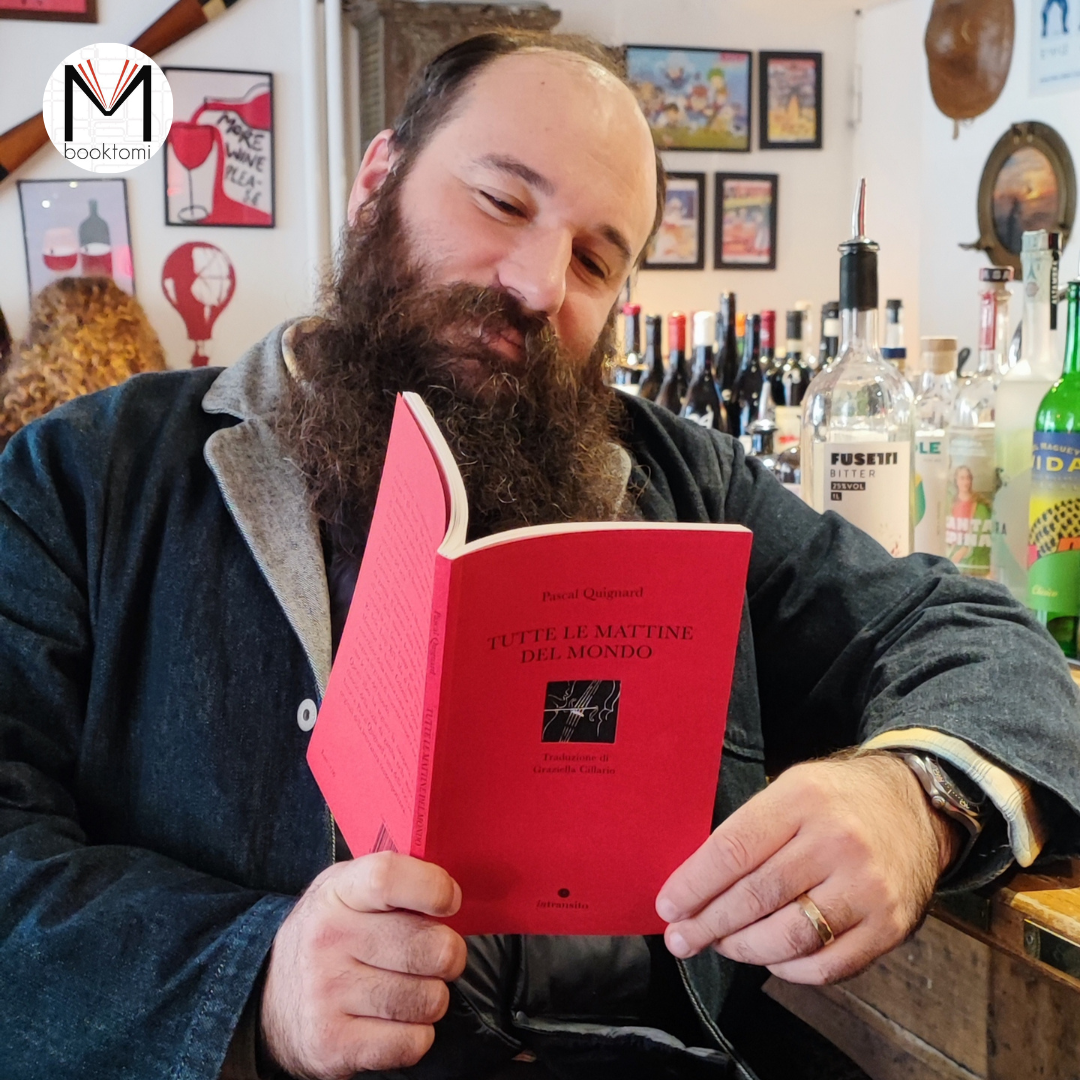
“FRIDAY RE-VERSO”
“Do you have a heart to feel? Do you have a brain to think?
1650. Monsieur de Sainte-Colombe, a musician and composer, is left a widower with two daughters, Madeleine and Toinette. He retreats to a small house by the river—a place seemingly outside of time—where he instructs his children in music, spurning every invitation to leave his “court of willows,” even declining an invitation from the King. Especially the invitation from the King. “I am such a savage, sir, that I believe I belong only to myself.” The only person to intrude upon this realm of solitude—aside from the lingering memory of his wife—is the young, headstrong Marin Marais. By insinuating himself into the private world of the Sainte-Colombe family, Marais learns the art of music, yet perhaps never truly manages to discern the melody of the world itself.
Pascal Quignard is an enigmatic figure (which only endears him to us); his books seem to speak of things he knows with absolute certainty, yet he expresses them through riddles, as if concealing the answers within the exquisitely refined folds of his prose. In this short novel, the human condition and the mysterious engage in an incessant dialogue: body and ambition, grief and desire, freedom and all the rest. At the heart of every event lies music—not merely a matter of instruments, but of life itself, nurtured through an inseparable bond between vocation and dedication. And here lies the central dilemma: does talent require validation? Does it need an audience?
“Sir, you seek to please a visible king. Pleasing others is not for me. I cast my call—I swear it—toward something invisible.”
And what if the young pupil wishes to play for the very king his master has so fiercely rejected? What if the student craves recognition and all that comes with it? Does he still deserve to learn? The title. We believe that the poignant longing and beauty of these spare, precise, and violent pages lie in the very words that make up the title: “All the mornings of the world are beyond return.” Inevitably, no moment can ever be reclaimed. Every step is a step forward—even when we delude ourselves into retracing our path, searching for that crossroads where things might have taken a different turn. Yet, a mistake is a small death—sometimes a necessary one—that allows us to be reborn to ourselves; perhaps it is a way to avoid betraying one’s own soul, to embrace this destiny of ours: an eternal progression with no possibility of turning back. Within the finality of this absolute statement, there also lies an immense, dawn-like clarity—an invitation to that *carpe diem* whispered by Professor Keating into the fearful ears of his students. Monsieur de Sainte-Colombe is not that kind of teacher; he is stern, gruff, consumed by melancholy, and as devoted to music as if it were his very fate.
And yet, this succession of mornings that never return—which both afflicts and blesses us all—eventually leads him, now an old man, to recognize the dignity of a life lived differently from his own. At the same time, that once-arrogant and ambitious pupil discovers a void within his own mornings—a void left precisely where he had either refused or failed to hear what his master was trying to convey, without ever offering an explicit explanation.
“Sir, may I ask for one last lesson?”
“Sir, may I attempt a first lesson?”
Curtain.
Written by Delis
____________________________________________________________________________________________________
Pascal Quignard, Tutte le mattine del mondo, Intransito, Milano, 2026
Original Edition: Tous les matins du mondem, Gallimard, Paris, 1991